
Catherine Spears Frye Carpenter: The Forgotten Mother of Bourbon’s Revolution
In the pantheon of American distilling, names like Elijah Craig, James Crow, and Jacob Beam shine brightly, their legacies etched into every bottle of bourbon that graces liquor store shelves. Yet conspicuously absent from this hallowed roster is Catherine Spears Frye Carpenter, a woman whose 1818 innovation fundamentally transformed the bourbon industry and established the technical foundation upon which America’s native spirit would be built. Her crime? Being a woman in an era when female achievement was systematically erased, when the intellectual and technical contributions of women were either attributed to men or simply allowed to fade into obscurity. Catherine’s story is not merely one of historical injustice—it is a revelation that forces us to reconsider everything we think we know about who built American bourbon and why their stories matter.
Born in 1760, Catherine Spears would live to see the birth of a nation, the taming of a wilderness, and the creation of an industry that would become synonymous with American identity itself. She would also witness her own contributions disappear into the shadows, her name unknown to the millions who would benefit from her innovation. Today, as we seek to understand the true history of American distilling, Catherine Spears Frye Carpenter emerges not as a footnote but as a central figure whose rightful place is in the Distiller’s Hall of Fame—not as a token or a curiosity, but as a genuine pioneer whose technical brilliance and frontier resilience shaped the very character of bourbon whiskey.
The Invisible Women of Colonial Distilling
To understand Catherine’s significance, we must first excavate the buried history of women in American distilling. In colonial and frontier America, the production of spirits was not the exclusive domain of men operating commercial distilleries—it was essential household work, and that work fell predominantly to women. Distilling was considered as fundamental a domestic skill as baking bread or preserving vegetables, a necessary competence for any wife managing a frontier household where purchased goods were scarce and self-sufficiency was survival.
The historical record, fragmentary though it is, reveals a striking truth: when colonial men advertised for wives in newspapers, they frequently listed the ability to distill beer or spirits as a requirement, right alongside cooking and sewing. This wasn’t mere preference—it was economic necessity. In an era before refrigeration, before reliable supply chains, before the infrastructure of modern commerce, the ability to transform grain into shelf-stable spirits represented both practical value and potential income. Women distilled for medicinal purposes, creating tinctures and remedies that served as the primary healthcare in isolated communities. They distilled for preservation, converting perishable harvests into valuable commodities. And they distilled for commerce, producing spirits that could be traded, sold, or used as currency in cash-poor frontier economies.
Yet despite this ubiquity, women distillers have been almost entirely written out of the historical narrative. The reasons are manifold and interconnected. First, much of women’s distilling work occurred in domestic spaces and was therefore considered “household production” rather than “real” commerce, even when women were selling their products. Second, legal and social structures prevented women from owning property or businesses in their own names, meaning their work was often legally attributed to husbands or male relatives. Third, the professionalization and industrialization of distilling in the 19th century deliberately excluded women, transforming what had been a mixed-gender craft into a masculine domain. And fourth, the historical record itself was created primarily by men who simply didn’t consider women’s work worth documenting.
This systematic erasure means that when we encounter a figure like Catherine Spears Frye Carpenter—a woman whose innovation was so significant that it couldn’t be entirely forgotten—we must recognize her not as an exception but as a representative of countless women whose contributions have been lost. Catherine’s story survived, barely, in handwritten recipes and family records. How many others disappeared completely?
A Sixteen-Year-Old Bride Enters the Wilderness
Catherine’s journey into history began in 1776, the year of American independence, when she was just sixteen years old. Newly married to John Frye, she made a decision that would have daunted many seasoned frontiersmen: she would follow kin and neighbors west into the untamed wilderness of Kentucky. This was not the Kentucky of today, with its manicured horse farms and tourist-friendly bourbon trails. This was a landscape of genuine danger, where Native American tribes fought desperately to defend their ancestral lands from encroaching settlers, where disease could wipe out entire families, where the nearest neighbor might be miles away through trackless forest, and where a single mistake—a poorly preserved harvest, a contaminated water source, a moment of inattention—could mean death.
For a teenage girl raised in more settled regions, the Kentucky frontier represented a complete rupture from everything familiar. Yet Catherine not only survived—she thrived. She and John established themselves as part of the wave of settlers who would transform Kentucky from wilderness into farmland, from territory into state. They raised cattle, cultivated crops, and built a homestead that would eventually become known as Carpenter’s Station, a name that would be associated with quality whiskey production.
The physical demands of frontier life were extraordinary. Catherine would have been responsible for an exhausting array of tasks: cooking over open fires, preserving food for winter, making soap and candles, spinning and weaving cloth, tending gardens, caring for livestock, and raising children—all while maintaining the vigilance necessary to survive in a dangerous environment. That she also found the time, energy, and intellectual capacity to innovate in the complex technical field of distilling speaks to a remarkable combination of intelligence, determination, and skill.
Distilling was not simple work. It required understanding fermentation chemistry before the science of chemistry was formalized. It demanded precise temperature control using primitive equipment. It necessitated careful attention to timing, proportions, and process. And it required the kind of experimental mindset that could observe, hypothesize, test, and refine—the very essence of scientific method. Catherine possessed all of these qualities, and she would use them to create something revolutionary.
The Sour Mash Revolution: Catherine’s 1818 Innovation
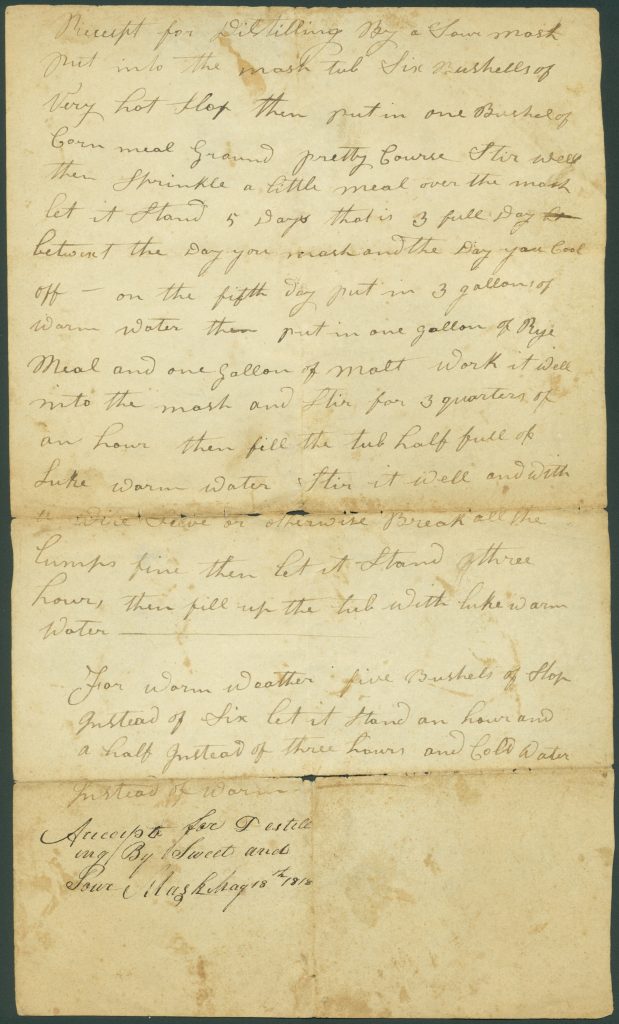
In 1818, Catherine Spears Frye Carpenter documented what would become the first known recipe for sour mash whiskey, a technique that would transform bourbon production and establish the standard process still used by distilleries today. The recipe, preserved in handwritten form, specified the use of a 100-gallon tub, six bushels of available grains and meal, steeped in boiling water—but the true innovation lay not in the ingredients but in the process.
Sour mash fermentation involves using a portion of previously fermented mash (the spent mash from a previous distillation) as a starter for the next batch. This “backset” or “setback” serves multiple crucial functions that Catherine either understood intuitively or discovered through careful experimentation. First, the acidic nature of the spent mash lowers the pH of the new fermentation, creating an environment that favors the growth of desirable yeast strains while inhibiting harmful bacteria. This was critical in an era before sterile technique or laboratory-cultured yeasts—the sour mash process essentially created a form of biological quality control.
Second, the use of backset ensured consistency from batch to batch. In traditional “sweet mash” production, each fermentation started fresh, meaning that variations in wild yeast populations, ambient temperature, or water chemistry could produce wildly different results. Sour mash fermentation created continuity, with each batch carrying forward the microbial profile of its predecessor. This meant that a distiller could develop a house character, a consistent flavor profile that customers could recognize and trust.
Third, the sour mash process was more efficient, extracting more fermentable sugars from the grain and producing higher alcohol yields. In a frontier economy where grain was valuable and waste was unacceptable, this efficiency represented real economic advantage.
Catherine’s recipe demonstrated sophisticated understanding of these principles. The specification of a 100-gallon tub suggests she was working at a scale beyond mere household production—this was commercial distilling. The use of “available grains and meal” indicates flexibility and adaptability, the mark of an experienced distiller who understood that the process mattered more than rigid adherence to specific ingredients. The instruction to steep in boiling water shows attention to the gelatinization of starches necessary for fermentation.
What makes Catherine’s innovation even more remarkable is its timing. In 1818, the science of fermentation was not yet understood. Louis Pasteur wouldn’t publish his groundbreaking work on yeast and fermentation until the 1850s and 1860s. Catherine was working in an era when the mechanisms of alcohol production were mysterious, when distillers relied on tradition, observation, and experimentation rather than scientific theory. Yet she developed a technique that modern science would later validate as superior.
The sour mash process that Catherine documented would become the foundation of bourbon production. Today, virtually all bourbon is made using sour mash fermentation. When you drink Maker’s Mark, Jim Beam, Wild Turkey, or any of the other iconic bourbon brands, you are experiencing the legacy of Catherine’s innovation. The technique she pioneered in a frontier distillery using primitive equipment has been refined and scaled but never fundamentally changed. It remains the gold standard because Catherine got it right the first time.
The Systematic Erasure of Women’s Achievements
Despite the revolutionary nature of her contribution, Catherine Spears Frye Carpenter’s name is virtually unknown outside of specialized historical circles. This erasure was not accidental—it was the predictable result of systematic forces that devalued and obscured women’s work.
As the 19th century progressed, distilling underwent a transformation from household craft to industrial enterprise. This professionalization was explicitly gendered. Commercial distilleries were male spaces, operated by men, owned by men, and marketed to men. The domestic distilling that women had performed for generations was increasingly dismissed as amateurish or irrelevant, even though it had been the source of most spirits production for centuries.
Legal structures reinforced this exclusion. Married women in the early 19th century could not own property in their own names in most states. This meant that even when women operated distilleries, the legal ownership belonged to their husbands. When Catherine’s husband John Frye died and she later married a man named Carpenter, her distilling work would have been legally attributed to him, regardless of who was actually doing the work.
The historical record itself was created by men who often didn’t consider women’s technical achievements worth documenting. When histories of bourbon were written, they focused on the men who owned large commercial operations, not the women who had developed the techniques those operations used. Catherine’s recipe survived because it was written down and preserved by family members who recognized its value, but how many other innovations by women distillers were never recorded at all?
There’s also a darker element to this erasure: the deliberate appropriation of women’s innovations by men. Throughout history, women’s inventions and discoveries have been credited to male colleagues, husbands, or employers. While we don’t have evidence that Catherine’s specific innovation was claimed by a man, the sour mash technique became associated with male distillers like Dr. James Crow, who worked at the Old Oscar Pepper Distillery in the 1830s and is often credited with “perfecting” sour mash bourbon. Crow was undoubtedly a skilled distiller, but he was building on a foundation that Catherine had established nearly two decades earlier.
The erasure of women from bourbon history also served ideological purposes. As bourbon became increasingly identified with masculine identity—rugged frontiersmen, cowboys, businessmen—the presence of women in its creation story became inconvenient. The mythology of bourbon required male heroes, and so female pioneers like Catherine were simply written out of the narrative.
Why Catherine Belongs in the Distiller’s Hall of Fame
The case for Catherine Spears Frye Carpenter’s inclusion in the Distiller’s Hall of Fame rests on multiple pillars, each of which would be sufficient on its own, but which together create an overwhelming argument for recognition.
Technical Innovation: Catherine developed the first documented recipe for sour mash whiskey, a technique that became the foundation of bourbon production and remains the industry standard more than two centuries later. This is not a minor refinement or a forgotten curiosity—it is a fundamental innovation that shaped an entire industry. Any hall of fame that claims to honor the pioneers of distilling but excludes the woman who created sour mash fermentation is incomplete and inaccurate.
Historical Significance: Catherine’s work occurred at a crucial moment in American history, when Kentucky was transitioning from frontier territory to established state, when bourbon was evolving from rough frontier whiskey to a distinctive American spirit. Her innovation helped establish the technical foundation that would allow bourbon to develop its characteristic flavor profile and quality consistency. Without sour mash fermentation, bourbon as we know it would not exist.
Resilience and Determination: Catherine’s achievements occurred in the context of extraordinary hardship. She was a frontier woman managing a household, raising a family, and operating a commercial distillery in an environment of genuine danger and deprivation. She lived to be 87 years old, dying in 1848 as “the last of the hardy band of pioneers.” Her longevity and productivity speak to remarkable physical and mental toughness.
Business Acumen: The scale of Catherine’s operation—100-gallon fermentation tubs, six bushels of grain—indicates that she was running a commercial enterprise, not just producing for household consumption. She was supporting her family through cattle raising and distilling, demonstrating the business skills necessary to succeed in a frontier economy. She was an entrepreneur in an era when women were legally barred from most forms of business ownership.
Educational Legacy: Catherine’s decision to document her recipe in writing demonstrates an understanding of the importance of knowledge transmission. She wasn’t content to keep her innovation as trade secret or oral tradition—she wrote it down, ensuring that others could learn from and build upon her work. This commitment to education and knowledge sharing is a hallmark of great innovators.
Representative Significance: Catherine represents the countless women whose contributions to distilling have been erased from history. Honoring her is not just about recognizing one individual—it’s about acknowledging the hidden history of women’s work in creating American spirits. Her inclusion in the Hall of Fame would begin to correct a historical injustice and inspire research into other forgotten female pioneers.
The arguments against Catherine’s inclusion are revealing in their weakness. Some might argue that we don’t know enough about her life to justify recognition—but this scarcity of information is itself a product of the systematic devaluation of women’s achievements. We know far less about Catherine than we do about male distillers of her era, not because she was less important, but because no one bothered to document her work with the same care. Should we compound this historical injustice by using it as a reason for continued exclusion?
Others might argue that her innovation was simply a refinement of existing techniques rather than a true invention. But this standard is never applied to male distillers, who are regularly celebrated for incremental improvements and process refinements. Moreover, the sour mash technique was genuinely revolutionary, not incremental—it represented a fundamental change in fermentation methodology with far-reaching consequences.
The truth is that Catherine Spears Frye Carpenter meets or exceeds every reasonable criterion for inclusion in the Distiller’s Hall of Fame. Her exclusion is not based on merit but on the historical devaluation of women’s work.
Rewriting the History of American Bourbon
Recognizing Catherine’s contributions requires us to fundamentally reframe the history of American bourbon. The traditional narrative presents bourbon as the creation of male pioneers—farmers and entrepreneurs who tamed the wilderness and built an industry through masculine virtues of strength, independence, and innovation. This narrative isn’t entirely false, but it’s woefully incomplete.
The true history of bourbon is a story of collaboration between men and women, of household production scaling up to industrial enterprise, of techniques developed in domestic spaces being adopted by commercial operations. Women like Catherine were not peripheral to this story—they were central to it. They developed the recipes, refined the techniques, and produced the spirits that established bourbon’s reputation for quality.
When we restore women to the bourbon narrative, we also restore complexity and nuance. We see that innovation came from unexpected places—not just from wealthy distillery owners but from frontier housewives working with limited resources. We understand that the development of bourbon was not a linear progression of male genius but a messy, collaborative process involving people of different genders, classes, and backgrounds. We recognize that the skills traditionally dismissed as “women’s work”—the careful attention to fermentation, the precise control of temperature and timing, the patient observation and experimentation—were actually the technical foundations of the industry.
This reframing also has contemporary relevance. The bourbon industry today is experiencing a renaissance, with women increasingly taking on roles as master distillers, blenders, and brand ambassadors. But these women are often presented as pioneers, as if they’re doing something unprecedented. Recognizing Catherine and her contemporaries reveals that women have always been part of bourbon production—they were just written out of the history. Today’s female distillers aren’t breaking new ground; they’re reclaiming ground that was always theirs.
The Broader Implications: Countless Lost Stories
Catherine’s story illuminates a larger truth about historical erasure and the importance of recovery work. For every Catherine whose innovation was documented and preserved, how many other women distillers left no trace? How many recipes were lost? How many techniques were developed by women but attributed to men? How many businesses were operated by women but legally owned by their husbands?
The historical record is not a neutral documentation of what happened—it’s a selective account shaped by the biases and blind spots of those who created it. When we accept this record uncritically, we perpetuate those biases. When we do the difficult work of excavating buried histories, we don’t just add names to lists—we fundamentally change our understanding of how industries developed, how innovation occurred, and who contributed to the building of American culture and economy.
Catherine’s story also reminds us that innovation often comes from unexpected sources. The woman working in a frontier distillery with primitive equipment was able to develop a technique that would become the industry standard. This should make us question our assumptions about where innovation happens and who is capable of it. How much potential innovation are we missing today because we’re not looking in the right places or listening to the right voices?
Furthermore, Catherine’s erasure and recovery demonstrate the importance of documentation and advocacy. Her recipe survived because someone—probably family members—recognized its value and preserved it. Her story is being recovered because historians and bourbon enthusiasts are actively seeking out forgotten contributions. This work of recovery and recognition is ongoing and essential. Every time we uncover a forgotten pioneer, we make it easier to find the next one.
Conclusion: Catherine’s Rightful Place in History
Catherine Spears Frye Carpenter died on April 1, 1848, at the age of 87, having lived through the American Revolution, the establishment of Kentucky statehood, the War of 1812, and the early decades of bourbon’s development as a distinctive American spirit. She was buried beside her loved ones, remembered by her family as one of the hardy pioneers who had built a civilization from wilderness. But her contributions to the bourbon industry—contributions that would shape the character of America’s native spirit for centuries to come—were allowed to fade into obscurity.
This erasure was not inevitable. It was the result of specific choices and systemic biases that devalued women’s work, excluded women from commercial enterprise, and created historical records that focused exclusively on male achievement. Correcting this erasure is not about political correctness or token representation—it’s about historical accuracy and justice.
Catherine Spears Frye Carpenter belongs in the Distiller’s Hall of Fame because she earned that place through innovation, skill, determination, and impact. She developed the sour mash technique that became the foundation of bourbon production. She operated a commercial distillery on the Kentucky frontier while managing the extraordinary demands of pioneer life. She documented her innovation in writing, ensuring that her knowledge could be transmitted to future generations. And she did all of this in an era when women were systematically excluded from recognition and reward for their achievements.
Honoring Catherine is not just about correcting a historical oversight—it’s about fundamentally reframing our understanding of American bourbon. It’s about recognizing that the story of bourbon is not just a story of male pioneers but of women and men working together, often in domestic spaces, to create something distinctively American. It’s about acknowledging that innovation comes from unexpected places and that the skills traditionally dismissed as “women’s work” were actually the technical foundations of an industry.
When we pour a glass of bourbon today, we are experiencing the legacy of Catherine Spears Frye Carpenter. The sour mash process she pioneered ensures the consistency, quality, and character of the spirit in our glass. She deserves to be remembered not as a footnote or a curiosity but as a central figure in bourbon history—a pioneer whose innovation shaped an industry and whose story illuminates the hidden contributions of countless other women.
The Distiller’s Hall of Fame without Catherine Spears Frye Carpenter is incomplete. It’s time to correct that omission and give this remarkable woman her rightful place among the giants of American distilling. In doing so, we don’t just honor one forgotten pioneer—we begin the essential work of recovering the full, complex, collaborative history of how American bourbon was really made.
Leave a Reply